Rep ranges
Do 20 reps steal your strength? Do singles make muscles shrink and become dense? Court is now in session.
The sacred bro tablet
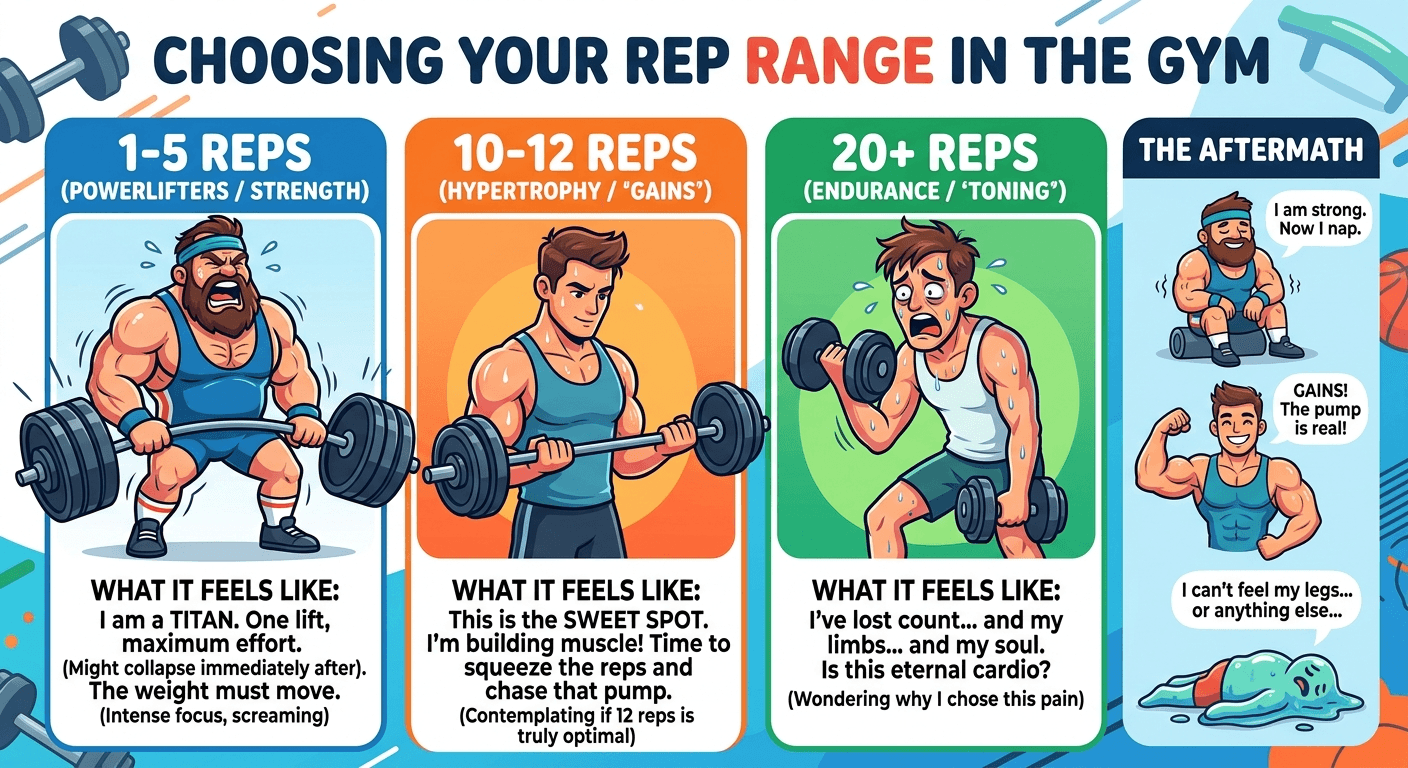
A legendary internet scroll says 20 reps grow muscle but delete strength, 12 reps grow muscle while strength stands still, seven reps achieve perfect cosmic balance, and one or two reps shrink muscles into ultra-dense lifting diamonds. Incredible lore. Terrible physiology.
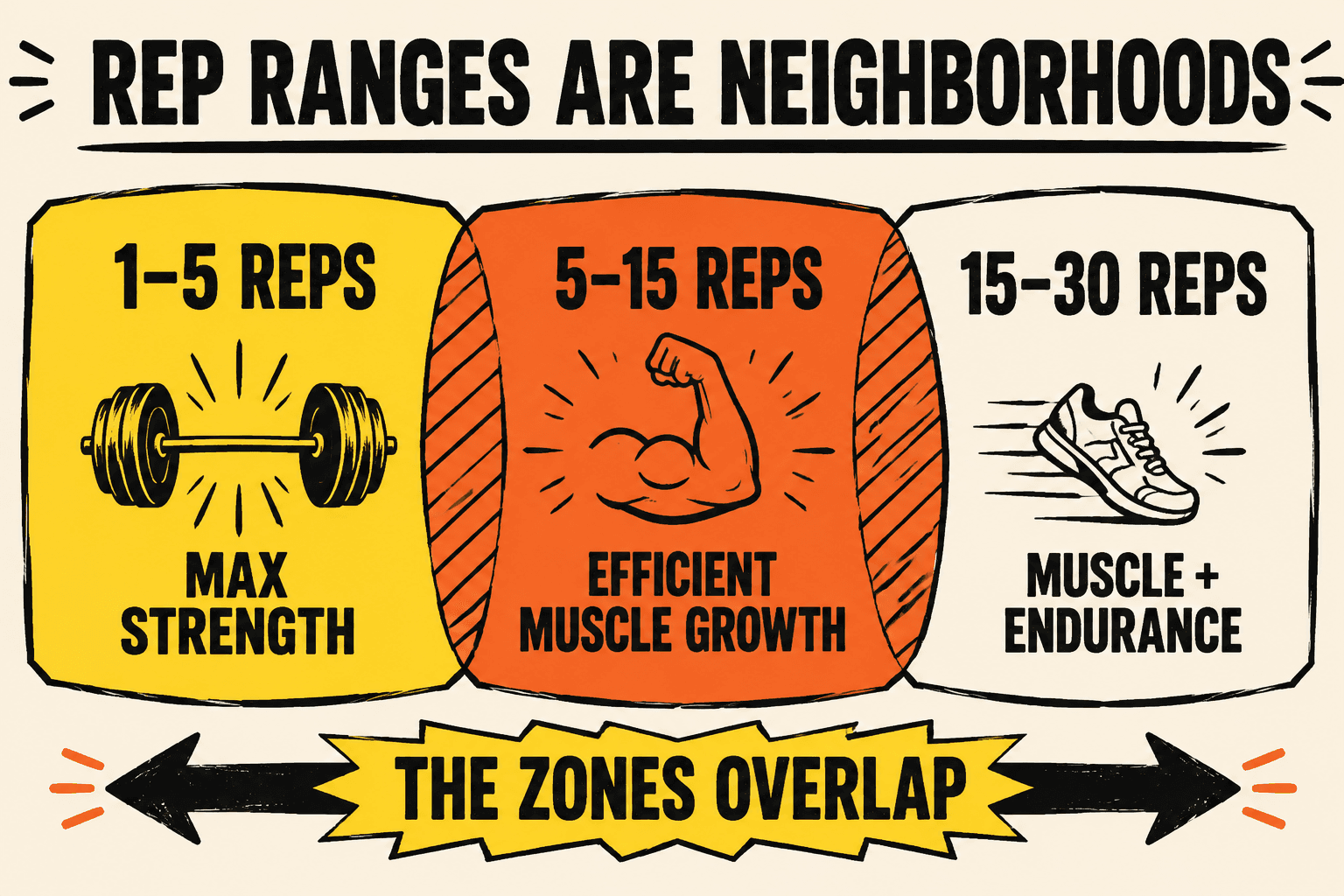
The verdict: no rep number flips muscle growth or strength on and off. Rep ranges overlap, and the useful range depends on the exercise, load, effort, training volume, and skill you want to practice.
What each range is actually good at
About 1–5 reps is useful for maximal strength because heavy loads give specific practice producing lots of force. Those sets can still grow muscle; your quads do not vanish because the set ended early.
About 5–15 reps is popular for muscle growth because it balances meaningful load, efficient volume, and tolerable discomfort. Eight to twelve is practical, not enchanted.
About 15–30 reps can also build muscle when sets are sufficiently challenging, while giving more muscular-endurance practice. It is usually less efficient and much more burny. The burn is a sensation, not a notarized growth certificate.
Effort matters, failure is not mandatory
A casual set of 12 with eight clean reps left in the tank is not automatically a better muscle-building set than a hard set of six. Lighter loads generally need to be taken closer to failure to recruit enough muscle fibers.
But you do not need to grind every set until the weight becomes furniture. Reviews do not show that momentary muscular failure is required for growth. Challenging, repeatable training beats turning every Tuesday into a survival documentary.
Your no-nonsense prescription
For maximal strength, include lower-rep heavy work with excellent technique. For muscle growth, do most work in ranges you can control, progress, and recover from. For endurance, use longer sets on purpose rather than as punishment for missing Monday.
Most good programs mix ranges: heavy practice for strength, moderate-rep work for efficient volume, and higher-rep accessories for targeted work with lighter loads. Progress load, reps, technique, or useful weekly volume over time. The blend matters more than defending one sacred number.
Sources
- ACSM 2026 Position Stand — Current synthesis of resistance-training prescription for strength and hypertrophy.
- Schoenfeld et al., 2017 — Heavier loads favored maximal strength; hypertrophy was similar across a broad load spectrum.
- Lopez et al., 2021 — Systematic review comparing low-, moderate-, and high-load resistance training.
- Refalo et al., 2023 — No evidence that momentary failure is superior to non-failure training for hypertrophy.